New York Attorney General Tackles Astroturfing

604269_25f0635b99When I traveled two weeks ago in a Western town I had never visited before, I relied on the Internet to find a sports bar where I could watch the Yankees on a nice big flat screen while having some good, simple food. I found a great sports bar on a consumer review website, and I had a relaxing evening, even though I was not really sure where I was (the GPS in my car knew it though).

That was because the online review I had read and relied upon was probably written by a real satisfied customer of that restaurant.

But what if the restaurant had paid a third party to write fake (gloating) reviews about the establishment in order to lure unsuspected customers like me to come in?

There is a name for that practice, astroturfing, and astrotrufing is illegal, as it violates laws against false advertising and is considered an illegal and deceptive business practice.

On September 23, New York Attorney General Eric T. Schneiderman announced that 19 companies have agreed to stop writing fake online reviews and to pay more than $350,000 in penalties. The NY AG named this undercover investigation “Operation Clean Turf.”

There are many sites on the web whose business model is to provide a platform for crowd-sourced information. Among the most popular of these sites are Yelp, CitySearch, and Google, which have collaborated with AG Schneiderman on the “Clean Turf Investigation.”

The NY AG Office started noticing about a year ago a flux of suspicious online reviews. This led undercover investigators, posing as owners of a yogurt shop in Brooklyn, asking several companies to provide fake positive online reviews for that shop. Many of the companies contacted were happy to help and offered fake review services. Most of these reviews are written by freelancers from all around the world, who post comments about places and businesses they do not know about. The NY AG Office found during its investigation that freelance writers from the Philippines, Bangladesh, or Eastern Europe were paid $1 to $10 per review.

This practice is a concern for consumer review websites, as astroturfing threatens their very business model, which relies on their visitors to trust the legitimacy of their online reviews. An article written by Professor Michael Luca (Harvard Business School) and Professor Georgios Zervas (Boston University), published this month, found that some 16% of restaurant reviews on Yelp are fraudulent.

Yelp prohibits deceptive and fake reviews through its Terms of Service, and even filed a complaint last month in the California Superior Court for San Francisco County, alleging that a San Francisco law firm had posted several fake online reviews about the firm and its legal services. The complaint notes that “[t]he integrity of Yelp reviews is fundamental to Yelp’s business model (at 15) and argues that the law firm has violated California’s false advertising laws.

The action of NY AG is the first of its kind in the U.S., but we should expect AG Offices from other states to follow, as the issue is not likely to go away soon. AG Schneiderman even called astroturfing “the 21st century’s version of false advertising.”

The Federal Trade Commission (FTC) will probably tackle the issue soon as well, under Section 5 of the FTC Act which empowers the FTC to prevent the use of unfair methods of competition and unfair or deceptive business practices. The FTC could also provide guidelines to consumer review websites on best practices.

France has recently taken an interesting view on the issue. The French Association for Standardization, the AFNOR, published on July 4 a new NF Z74-501 norm about online consumer reviews. Websites may comply, on a voluntary basis, to a set of rules and procedures for reliable methods of treating and collecting online reviews of consumer products and services. If they do comply with the rule, they may post the NF Z74-501 seal of compliance on their site.

Whether or not astroturfing is prevented or its illegal use prosecuted by authorities, it is certainly a bad weed. (Sorry!)

Image is area 51 courtesy of Flickr user Michael Newton pursuant to a CC BY 2.0 license.


Facebooktwitterredditpinterestlinkedinmailby feather

‘The Fitchuation’ T-Shirt Did Not Infringe ‘The Situation’ Trademark

4490088209_be2158df1cMichael Sorrentino, a former Jersey Shore cast member, recently lost his trademark infringement suit against retailer Abercrombie & Fitch (A&F).

Sorrentino was part of the cast of the (in)famous MTV reality television show from its December 2009 start. He gave himself the nickname ‘The Situation’ or ‘Sitch.’ The show quickly became popular and, on February 2010, A&F started selling on its web site t-shirts with “The Fitchuation” printed in front, a word play on ‘The Situation.’

However, A&F’s interest in Sorrentino and the Jersey Shore show turned quickly into disdain. When casts members, including Sorrentino, wore A&F clothing on the show, A&F released a statement in August 2011 stating that “[it was] deeply concerned that Mr. Sorrentino’s association with [its]brand could cause significant damage to [its] image.” A&F even offered up to $10,000 to Sorrentino and other members of the cast NOT to wear A&F apparel. (See August,16  2011 press release here)

Sorrentino owns with his brother Marc the MPS Entertainment Limited Liability Company, which holds several ‘The Situation’ registered trademarks. The trademark applications were filed late 2010, and the company sells apparel on its web site, some of them bearing ‘The Situation’ trademark.

Sorrentino and MPS (Plaintiffs) filed a trademark infringement suit in 2012 against A&F (Defendant), claiming that A&F infringed on their trademark ‘The Situation’ by selling and advertising its ‘Fitchuation’ t-shirts. On June 28, 2013, the Southern District of Florida granted summary judgment to Defendant, finding no trademark infringement.

No Likelihood of Consumer Confusion

The Southern District Court of Florida belongs to the 11th Circuit, and thus used the Alliance Metals v. Hinely Indus. Inc. multifactor test for likelihood of consumer confusion. These seven factors are:

–          Strength of the mark

–          Similarity of the mark

–          Comparison of the goods and services

–          Similarity of the parties retail outlets and customers

–          Similarity of Advertising media

–          Defendants’ intent

–          Actual confusion in the consuming public

Strength of the mark: Trademarks are traditionally classified by courts and commentators as (1) generic, (2) descriptive, (3) suggestive or (4) arbitrary or fanciful (see Zatarain’s Inc. v. Oak Grove Smokehouse, Inc). Arbitrary or fanciful terms “bear no relationship to the products or services to which they are applied” (Zatarain) and do not have to prove that they have acquired secondary meaning for the public, that is, that the public recognizes a particular term as designating a particular product. Think as an example ‘Apple’ designating a cell phone, not a fruit.

The Southern District Court of Florida found that ‘The Situation’ is an arbitrary and fanciful mark, as it bears no relationship to the product or service.

Similarity of the mark: Defendant had argued that ‘The Fitchuation’ t-shirt was a parody. The court did not elaborate on this argument, but nevertheless weighed in favor of Defendant on that factor. It noted that Defendant had used its own ‘Fitch’ trademark and that had reduced the likelihood of consumer confusion. The court also noted that “The Fitchuation” is “visually and phonetically different that “The Situation.””

Comparison of the goods and services: This factor weighed in favor the Defendant as there was no evidence that the public had confused its products with those of Plaintiff which, indeed, had not even started selling its own t-shirt line at the time A&F sold its ‘Fitchuation’ t-shirt.

Similarity of the parties retail outlets and customers: A&F sold its t-shirt exclusively though its stores and web site. There was no similarity of sales channels here, and there was no similarity of advertising media either.

As for Defendants’ intent, A&F did not have the intent to misappropriate the plaintiff’s goodwill. The t-shirt was a parody, and was not sold it to profit from Plaintiffs’ business reputation. The court cited the 1987 10th Circuit case Jordache Enterprises, Inc. v. Hogg Wyld, Ltd. where the court had found no likelihood of confusion between Jordache blue jeans and Lardasche blue jeans for plus size women, sold complete with a smiling pig and the word ‘Lardashe’ on the back of the pants.

Finally, there was no Actual confusion in the consuming public Plaintiff did not present any evidence to the contrary, and the court rejected a survey presented by Plaintiff as evidence as defective.

For all these reasons, the Southern District of Florida granted summary judgment to A&F on the trademark infringement claim.

Barring ‘Undesirable’ Customers from Wearing one’s Goods (Not a Good Idea!)

From the August 16, 2011 A&F press release about Jersey Shore cast members wearing A&F clothing:

We are deeply concerned that Mr. Sorrentino’s association with our brand could cause significant damage to our image.  We understand that the show is for entertainment purposes, but believe this association is contrary to the aspirational nature of our brand, and may be distressing to many of our fans.”

A&F is using the term “brand,” not “trademark.”A brand refers to the whole package, going to the store, emulating the models featured  in the catalog and adhering to company’s ‘values.’ A&F has “fans,” not customers, and the brand is “aspirational,” meaning that the customers buy the goods to emulate a certain lifestyle, most of the time a lifestyle above their current socio-economical mean. A customer may buy and wear, say, a branded tee-shirt, because he aspires to be part of the happy-few set wearing that particular brand. But what if some customers deemed ‘undeserving’ by a brand do start wearing its products?

You Are Not Worthy!

In 2005, Burberry was desperate to prevent ‘Chavs’ from wearing its famous check. At the time, they particularly favored a certain Burberry baseball cap. ‘Chavs’ gained the reputation to party (very) hard, and the Burberrys baseball cap became a symbol of infamy. Some night clubs even started banning them and Burberry eventually decided to stop producing them.

A&F is notorious for seeking to prevent some people from wearing A&F goods. After an A&F manager reportedly peeped that poor people should not wear A&F clothing, Greg Karber, a LA-based writer launched a campaign on You Tube urging people to donate A&F clothing to homeless people.

In essence, what Mr. Karber was trying to achieve is a non-commercial dilution of the brand. The Lanham Act prevents dilution of the distinctive quality of a famous mark, but the use has to be commercial. It defines dilution by tarnishment as an “association arising from the similarity between a mark or trade name and a famous mark that harms the reputation of the famous mark.” Let’s hope that there will never, ever, be  a bill proposing that wearing a brand while not being ‘worthy’ of it could be deemed tarnishment as well.

Image is Snooki & The Situation: The Egg Version courtesy of Flickr user chicagogeek pursuant to a CC BY 2.0 license.


Facebooktwitterredditpinterestlinkedinmailby feather

SCA Protects Privacy of Non-Public Facebook Wall Posts

5454778149_620c36dbfeThe U.S. District Court for the District of New Jersey ruled on August 20 that non-public Facebook wall posts are covered by the Stored Communications Act (SCA). However, the authorized user exception applied in this case, as a colleague who had legally access to Plaintiff’s Facebook wall had forwarded the controversial  post, unsolicited, to their common employer.

The case is Ehling v. Monmouth-Ocean Hospital.

Plaintiff Deborah Ehling was as registered nurse and paramedic working for Defendant Monmouth-Ocean Hospital Service Corp. (MONOC). In June 2009, she posted a message on her account, implying that the paramedics who took care of the man who had killed a security guard outside the U.S. Holocaust Memorial Museum in 2009 should have let him die.

The privacy settings of Ehling’s Facebook account limited access to her Facebook wall to her Facebook friends. No MONOC managers were her Facebook friends, but several of her MONOC coworkers were, including Tim Ronco, who apparently decided on his own to provide screenshots of the controversial Ehling’s Facebook post to a MONOC manager.

Plaintiff was then suspended with pay and was told that her comment reflected a “deliberate disregard for patient safety.” Plaintiff then filed a complaint with the National Labor Relations Board (NLRB) which found that MONOC had not violated Ehling’s privacy as the post had been sent unsolicited to management.

Plaintiff was eventually fired, and filed an action against MONOC,  but the court granted defendant’s motion for summary judgment. I will only talk about the violation of the SCA.

Stored Communications Act

Plaintiff claimed that Defendant had violated the SCA when accessing the messages posted on her Facebook wall.

The SCA, 18 U.S.C. § 2701, is part of the Electronic Communications Privacy Act (ECPA) of 1986. The SCA forbids unlawful access to stored communications, that is,“(1)intentionally access[ing]s without authorization a facility through which an electronic communication service is provided; or (2) intentionally exceed[ing] an authorization to access that facility.”

According to the Ehling court, Facebook wall posts are indeed electronic communications as defined by 18 U.S.C. § 2510(12) that is,“any transfer of signs, signals, writing, images, sounds, data, or intelligence of any nature transmitted in whole or in part by a wire, radio, electromagnetic, photoelectronic or photooptical system that affects interstate or foreign commerce.”

Facebook’s users transmit data over the Internet, from their devices to Facebook’s servers, and thus their posts are electronic communications within the meaning of the SCA. No new issue here. The New Jersey court cited the 2010 Central District Court of California case, Crispin v. Audigier, which stated that Facebook and MySpace were electronic communications providers. Again, nothing new.

Finally, Facebook posts are saved on its servers indefinitely, thus backing them up. Therefore, Facebook wall posts are in electronic storage within the meaning of the SCA, 18 U.S.C. § 2510(17)(B), which defines the storage of electronic communications for purposes of backing them up. We are all set, the SCA applies in this case.

Public Electronic Communications/Private Electronic Communications

The controversial issue was instead whether Plaintiff’s Facebook posts were public or private. This is important, as the ECPA only protects private communications. The Ninth Circuit had noted in the 2002 case Konop v. Hawaaiian Airlines, Inc. that “the legislative history of the [SCA} suggests that Congress wanted to protect electronic communications that are configured to be private, such as email and private electronic bulletin boards.”

But a completely public BBS is not protected by the SCA. Indeed, the SCA legislator wrote that:

the bill does not for example hinder the development or use of electronic bulletin boards or other similar services where the availability of information about the service, and the readily accessible nature of the service are widely known and the service does not require any special access code or warning to indicate that the information is private. To access a communication in such a public system is not a violation of the Act, since the general public has been ‘authorized’ to do so by the facility provider”. (S. REP. NO. 99-541, at 36)

Konop was cited in Crispin v. Audigier, where the court reasoned that “there is no basis for distinguishing between a restricted-access BBS and a user’s Facebook wall or MySpace comments.” The New Jersey District court cited Audigier to conclude that non-public Facebook wall postings are covered by the SCA.

As the privacy settings of Plaintiff’s Facebook account prevented non-Facebook friends to access the messages on her wall, these messages were not really “public” and therefore the SCA applied to them. However, the authorized user exception of the SCA applied in this case.

Why the SCA’s Authorized User Applied in this Case

There is no liability under the SCA if access “[is] authorized … by a user of that service with respect to a communication of or intended for that user,” 18 U.S.C. § 2701(c)(2).

The court cited its own 2009 Pietrylo v. Hillstone Rest. Grp. case which had found that there is no violation of the SCA if the access to an electronic communication has been authorized. In the Pietrylo case, the manager of a restaurant had accessed the MySpace account of an employee, accessible only by invitation, by asking another employee to provide him the password. In Ehling, one of Plaintiff’s colleagues had voluntarily forwarded the electronic communication to the employer “without any coercion or pressure.” Therefore, the access was authorized. The difference is there, asking/coercing for access, or learn about the communication from an unsolicited third party.

Take away

Case law is consistent in this issue. While employers should not coerce or pressure employees to provide them access to the social media account of another employee, it is not illegal for them, under the SCA, to access a social media post if a third party willingly shares this information with them.

As for providing access to one’s own social media account to one’s employer, New Jersey recently enacted a law prohibiting employers to ask for user names, passwords, or other means for accessing employee’s electronic communications devices. Several states have similar laws, but New York is not one of them yet.

Image is Facebook wall courtesy of Flickr user Marcin Wichary pursuant to a CC BY 2.0 license.


Facebooktwitterredditpinterestlinkedinmailby feather

Plaintiffs Appeal in Manhattan Privacy Case

2890653367_3beb209a81Plaintiffs who lost last month their privacy case against a photographer who had taken pictures of them and their children without permission filed a notice of appeal to the Appellate Division of the New York Supreme Court on September 5.

This is an interesting case about balancing two competing interests, the right to privacy and the right to freedom of expression.

Using a telephoto lens, defendant Arne Svenson took several photographs of people living in the building across from his own apartment in Manhattan, taking advantage of the fact that the building is a glass tower with floor-to-ceiling windows for each apartment. People are shown going on with their daily activities, having their breakfast, cleaning or sleeping.

Svenson did not ask for permission to take these pictures and later used these images for an exhibition, “The Neighbors” presented this year at a Chelsea art gallery.

Some of the people photographed were minors, and their parents, Martha and Matthew Foster, filed suit individually and on behalf of their children against Svenson. Judge Eileen Rakower from the Supreme Court of New York granted on August 1 defendant’s motion to dismiss.

New York Privacy Law

The state of New York does not recognize a common law right of privacy. It only recognizes a right not to have one’s likeness used for commercial purposes, New York Civil Rights Law §§ 50 and 51. Under § 50,“[a] person, firm or corporation that uses for advertising purposes, or for the purposes of trade, the name, portrait or picture of any living person without having first obtained the written consent of such person, or if a minor of his or her parent or guardian, is guilty of a misdemeanor.” § 51 provides plaintiff for injunctive relief and damages.

Therefore, it is not illegal under New York law to use someone’s likeness without permission for a purpose which is not commercial. Plaintiff must prove to succeed in his claim the (1) use of his name, portrait, picture or voice (2) “for advertising purposes or for the purposes of trade” (3) without consent and (4) within the state of New York.

Svenson certainly used the likeness of plaintiffs. The faces of his subjects are not seen, but some of them are shown in “lost profile” which certainly would allow people knowing them to recognize them. The preliminary injunction sought to immediately end “the dissemination of two photographs showing the ‘[plaintiffs’] children faces and partially-clad bodies. “

So Svenson used the likeness of the plaintiffs, without their consent, within the state of New York. Was this use “for advertising purposes or for the purposes of trade”?

Trade/Advertising Purposes or Free Speech?

Plaintiffs alleged defendant’s photos constituted advertising and trade under §§ 50 and 51, as Svenson sold his photographs through the gallery which organized “The Neighbors” exhibition.

But their arguments did not convince Judge Rakower from the New York Supreme Court who found this was not a commercial use of the likeness of plaintiffs and their children. That is consistent with New York case law. For instance, in Simeonov v. Tiegs, the New York City Civil Court held in 1993 that” [a]n artist may make a work of art that includes a recognizable likeness of a person without her or his written consent and sell at least a limited number of copies thereof without violating Civil Rights Law §§ 50 and 51.”

Judge Rakower also noted that New York law protects freedom of expression, citing a 1982 New York Court of Appeals case, Arrington v. N.Y. Times. In Arrington, the photograph of plaintiff, taken without his permission in the streets of New York City, was later used to illustrate an article on “The Black Middle Class” in the New York Times magazine. The Court of Appeals ruled that the use was not commercial, even” though the dissemination of news and views is carried on for a profit or that illustrations are added for the very purpose of encouraging sales of the publications.”

Judge Rakower cited the Southern District of New York Hoepker v. Kruger case, where the SDNY ruled in 2002 that artist Barbara Kruger could use plaintiff Charlotte Dabney’s likeness in her “It’s a small world, but not if you have to clean it” work . The SDNY noted then that “[t]he advertising and trade limitation in New York’s privacy statutes was crafted with the First Amendment in mind. Through Sections 50 and 51, the New York legislature sought to protect a person’s right to be free from unwarranted intrusions into his or her privacy, while at the same time protecting the quintessential American right to freedom of expression.”

In our case, Judge Rakower reasoned that Svenson was “communicating his thoughts and ideas to the public” and that his photographs “serve more than just an advertising or trade purpose because they promote the enjoyment of art in a form of a displayed exhibition.” Even if the exhibition had been advertised, that was “beyond the limits of the statute because it related to the protected exhibition itself.

As plaintiffs could not establish a likelihood of success on the merits, the NY Supreme Court granted defendant’s motion to dismiss. Judge Rakower noted that “[w]hile it makes Plaintiffs cringe to think their private lives and images of their small children can find their way into the public forum of an art exhibition, there is no redress under the current laws of the State of New York.” It is doubtful that the Appellate Division will have a different view of the case, but we’ll see.

Image is Goat on a Ledge in Aruba,, courtesy of Flickr user Serge Melki pursuant to a CC BY 2.0 license.


Facebooktwitterredditpinterestlinkedinmailby feather

Marvel Wins Copyright Suit Against Jack Kirby’s Heirs

2708971745_a4680c8f56Jack Kirby needs no introduction to comic book lovers, as he is, according to the Second Circuit decision I am commenting today, “considered one of the most influential comic book artists of all time.”

Here are the facts of the case. In September 2009, the four children of Jack Kirby served Marvel, the comic book publisher, with termination notices, seeking to terminate all grants of copyright for works made by their father for Marvel before January 1, 1978, and any grants of copyright made prior to that date for a stated future date.

The works at stake were made between 1958 and 1963, and featured famous characters such as Spider Man, Hulk, or the Fantastic Four. Marvel and Kirby had executed a written agreement in 1972, which assigned to Marvel “any and all right, title and interest [Kirby] may have or control” in the work he had created for Marvel. Kirby also acknowledged that all the work he did for Marvel was done as an employee of Marvel.

Section 304(c) of the Copyright Act indeed gives authors and their heirs the right to terminate a grant of copyright fifty-six years after the original grant, unless another agreement to the contrary does exist.  However, grants in works made for hire cannot be terminated.

Marvel filed suit in January 2010 seeking the court to declare that the Kirbys had no right to terminate the transfers, as the works in contention were works-for-hire in which Marvel holds the copyright. Defendants filed a motion to dismiss the complaint, which was denied by the Southern District of New York (SDNY) on November 22, 2010.

The SDNY then granted summary judgment to Marvel on July 28, 2011, finding that the works at stake were indeed works-for-hire within the meaning of the Copyright Act of 1909, and that thus the termination notices did not convey the copyright in these works back to the Kirbys.

The heirs appealed to the Second Circuit, and on August 8, 2013, the Court affirmed the judgment as to two of the Kirbys and vacated the judgment as to the two siblings over which the SDNY had no personal jurisdiction. However, the Second Circuit did not find that they were indispensable parties to the suit under Fed. R. Civ. P. 19, and thus that the suit did not have to be dismissed in its entirety.

When are Works-Made-for-Hire?

Jack Kirby drew many comics for Marvel between 1958 and 1963. At this time, the copyright law was the Copyright Act of 1909, which still applies to all works published before January 1, 1978. Under the 1909 Act, an employer who hired someone to create a copyrightable work is the author of the work. However, the 1909 Act did not define what is an ‘employer’ or even a ‘work-for-hire,’ and that task fell to the courts.

In the Second Circuit, courts apply a two-pronged test, the “instance and expense” test, to determine if a work is made for hire under the 1909 Act. Under this test, the copyright belongs to the person at whose “instance and expense” the work was created. The hiring party induces the creation of the work and has the right to direct and supervises the manner the work is carried out (Martha Graham School and Dance Foundation. v. Martha Graham Center of Contemporary Dance, 2d Cir. 2004, at 635).

However, the Second Circuit noted that “inducement” or “control” may be so incidental that the copyright does not belong to the hiring party, and states that whether the test is indeed conclusive depends on what was the creative and financial arrangement between the parties for each case.

The “Marvel Method”

In this case, the SDNY explained how Stan Lee, the Marvel editor from sometimes in the 40’s until the early 1970’s, devised the “Marvel Method” during the 50’s. Before that, Lee prepared detailed scripts, featuring panel-by-panel breakdown of the stories that comic artists had to follow.

In order to accelerate the comics production, Lee stopped writing these detailed outlines to favor instead “plotting conferences” with the artists, where the plot for new stories where discussed. Lee and other Marvel artists testified that Lee described the plot to the artist during the conference. Lee then edited the work and added dialogues and captions. He also retained the right to approve the final work or to reject it altogether. This method allowed Lee to work with several artists simultaneously.

Kirby did not work without having received an assignment from Lee. However, evidence in the record showed that Kirby was given a somewhat freer hand, that is, was given more general instructions, not page-by-page instructions.

The Kirby’s works were created at Marvel’s instance

An employer may well direct and supervise an independent contractor, not only an employee, as courts focus on whether the hiring party had the right to control and supervise the work, that is, had the power to accept, reject, or modify the work.

In this case, the SDNY had found that there was a presumption that the works at stake had been created at Marvel’s ‘instance. The Second Circuit was of the same opinion, noting that Kirby’s works for Marvel from 1958 to 1963 “were hardly self-directed projects,” but, rather, that Kirby “created the… works pursuant to Marvel’s assignment.”

The Kirby’s works were created at Marvel’s expense  

There is an almost irrebutable presumption under the test that any person who paid another to create a copyrightable work is the author of the work.

Kirby paid for his own supplies, worked at home, and did not receive any benefits from Marvel. He was paid at a page rate multiplied by the number of pages, but never received royalties for his work.

However, Marvel argued successfully that it took the financial risks involved with publishing the works, and thus the works had been created at its expense. The Kirbys argued in front of the Second Circuit that it was instead their father who had taken the financial risks, by working and providing supplies without knowing for sure if his work would be accepted by Marvel. This argument did not convince the Second Circuit, as Marvel and Kirby had a standing engagement, where Kirby produced works following Marvel’s specs.

The Second Circuit found that Marvel had satisfied the instance and expense test, and that Kirby’s heirs failed to rebut the work-for-hire presumption. Therefore, the Second Circuit affirmed the judgment of the SDNY for the two parties under its jurisdiction.

The money interests at stake in this suit were high. Disney bought Marvel in 2009 for four billion dollars and has since released several movies about famous Marvel characters. It joined Marvel to defend the suit. Spider Man is now a Broadway play. A movie featuring the Thor character is scheduled for release next November.

Image is Spiderman for a day, courtesy of Flickr user chispita_666 pursuant to a CC BY 2.0 license.

Facebooktwitterredditpinterestlinkedinmailby feather

Nikita and Natasha

loveThe Seventh Circuit affirmed on July 17 a judgment of the Northern District of Illinois which had dismissed a copyright infringement suit brought against Elton John over his “Nikita” song by Guy Hobbs, an amateur songwriter.

Hobbs wrote the lyrics of a song, “Natasha,” inspired by a brief relationship he had in the Eighties with a Russian woman while working on a cruise ship. He registered the copyright for the lyrics in the U.K. in 1983, and, in 1984, forwarded the lyrics to be considered for publishing to Big Pig, a music publisher. Neither Big Pig nor any other music publisher ever published these lyrics.

In 2001, Hobbs read for the first time the lyrics of the song “Nikita,” written by Elton John and long-time collaborator Bernie Taupin, which had been copyrighted by Big Pig in 1985. Hobbs contacted the authors of the Nikita song, and since, according to the N.D. of Illinois, “has consistently communicated with [Elton John and Bernie Taupin] and their attorneys demanding compensation for the unauthorized use of his lyrics.”

Hobbs eventually filed suit for copyright infringement in April 2012. On October 29, 2012, the N.D. of Illinois granted defendants’ motion to dismiss in its entirety. Hobbs appealed, but the Seventh Circuit affirmed. Here are a few of the reasons Hobbs was not successful.

Titles Not Protected by Copyright

While the titles of both songs, “Nikita” and Natasha,” are somewhat similar, titles are not protected by copyright. The N.D. Court of Illinois had taken care to note that other songs sharing the same titles could be found when searching the Copyright Office’s database. Even if both titles contain a Russian name starting with “N” and ending in “A”, these elements are commonplace.

Ideas Are Not Protected By Copyright

Plaintiff argued in front of the N.D. Court of Illinois that both songs had for theme an impossible love between a Westerner and a Communist woman during the Cold war. But, as noted by the Seventh Circuit, “the Copyright Act does not protect general ideas, but only the particular expression of an idea.” 17 U.S.C. § 102(b) clearly states that “[i]n no case does copyright protection for an original work of authorship extend to any idea…”

The N.D. Court of Illinois had noted that the Cold War love affair has been for decades a common theme in songs, books, and movies. Indeed, if the theme of the western man in love of with a woman living beyond the Iron Curtain could be protected by copyright, French singer Gilbert Bécaud would have prevented all further songs using that theme, when he released his hit, Nathalie, in 1964, complete with an early “video clip” featuring the chanteur visiting Moscow in the company of a guide with almond-shaped pale eyes.

I mention the color of the guide’s eyes in the Bécaud’s clip, as plaintiff in Hobbs argued in front of the N.D. Court of Illinois that “a postal theme” and “references to a woman’s pale eyes” are protected by the Copyright Act. But the court’s lapidary answer was that such themes are “rudimentary, commonplace and standard under the scènes à faire doctrine.”

This is the doctrine under which scenes which “have to be done” are not protected copyright. Such scenes and themes, which are a necessary part of a work, are merely ideas. The Seventh Circuit quoted its own 2003 Bucklew v. Hawkins case, where it explained the doctrine of scènes à faire as meaning that “a copyright owner can’t prove infringement by pointing to features of his work that are found in the defendant’s work as well but that are so rudimentary, commonplace, standard, or unavoidable that they do not serve to distinguish one work within a class of works from another.”

Unique Combination

Even though individual elements were not protectable by copyright, Hobbs argued that the selection, arrangement and protection of these unprotectable elements constituted a “unique combination” which can be protected by copyright. The N.D. Court of Illinois rejected that argument as, in Peters v. West, the Seventh Circuit had held in 2012 that if parts of the works are not protectable by copyright on their own plaintiff cannot claim copyright infringement for the whole work. Hobbs only relied on the “unique combination” theory on appeal. But the Seventh Circuit held that there was not infringement as “even when the allegedly similar elements between the songs are considered in combination, the songs are not substantially similar” and thus the court did not need to decide if plaintiff’s argument was indeed correct.

The Two Songs are Not Similar

Instead, the Seventh Circuit reviewed the case de novo to find out whether both songs were substantially similar, which would then permit to infer that the defendant has copied the original work. When having to rule whether a particular work infringes another one, judges are looking at whether the allegedly infringing work is not substantially similar to the original work, meaning that they “do not share enough unique features to give rise to a breach of the duty not to copy another’s work,”Peters at 633-34.

The Seventh Circuit did not find that the two songs were similar. First,they do not tell the same story. In “Natasha,” the two lovers had a brief romance, but their relationship was doomed because “a Ukraine girl and a UK guy just never stood a chance.” Instead, the “Nikita” song is about a relationship that never could happen because Nikita lives on the other side of the wall, and thus the protagonist of the song “will never know how good it feels to hold [Nikita].”

Also, the expressions used in both songs are not similar. Natasha has “pale blue eyes,” Nikita has “eyes that looked like ice on fire.” Natasha never sent a Valentine to her lover, whereas the singer in Nikita does not know if the letters he sends to Nikita are even received.

Hobbs also contended that both songs used the word “never,”,the phrase “to hold you,” the phrase “I need you” and some form of the phrase “you will never know.” This argument was not conclusive either. As any regular listener of hit parades would know, these phrases were and are used regularly (too regularly? ) in pop songs, and the Seventh Circuit even noted that “[r]epetition is ubiquitous in popular music.”

As the songs were found not “substantially similar,” the Seventh Circuit concluded that there was no copyright infringement.

Image is Love courtesy of Flickr user  Alberto Garcia pursuant to a CC BY-SA 2.0 license.


Facebooktwitterredditpinterestlinkedinmailby feather

New York Senator Asks FTC to Allow Consumers to Opt Out of Store Tracking Programs

tracksI wrote a post yesterday on The Secure Times Online Forum, the online forum of the American Bar Association Section of Antitrust Law’s Privacy and Information Security Committee.

It is about the press conference held by Senator Charles Schumer (D-NY) last Sunday  in Manhattan, where he called on the Federal Trade Commission  to allow consumers to opt out of being tracked while visiting retail stores.

Senator Schumer suggested that the FTC should require retailers to inform consumers about their opt-out option by sending an electronic notice to their smartphones before starting to track them.

Senator Schumer also sent a letter to Edith Ramirez, the FTC chairwoman, asking the FTC to investigate this practice which he called unfair and deceptive.


Image is tracks courtesy of Flickr user  John-Morgan pursuant to a CC BY-SA 2.0 license.


Facebooktwitterredditpinterestlinkedinmailby feather

A Ballot Initiative Seeks to Add a Right to Privacy in PII to the California Constitution

privacyI wrote a post yesterday on The Secure Times Online Forum, the online forum of the American Bar Association Section of Antitrust Law’s Privacy and Information Security Committee.

It is about a recent ballot  initiative in California which seeks to have voters decide whether a right to privacy in personally identifiable information (PII) should be added to the California Constitution.


Image is privacy courtesy of Flickr user  doegox pursuant to a CC BY-SA 2.0 license.

Facebooktwitterredditpinterestlinkedinmailby feather

French Designer Isabel Marant Gains Rights to Delete Infringing Listing from Third Party Site

French fashion designer Isabel Marant has been steadily gaining international notoriety over the last decade. Some of her designs, such as the low cowboy boots, are particularly recognizable. Her special collection for H&M will be sold in November.

She is also savvy at starprotecting her intellectual property. Her group (Marant Group) recently resolved a dispute with the U.S. site iOffer.com by a settlement agreement which has been approved by the Paris Court of First Instance (scroll down for the English version of the agreement).

iOffer describes itself as “a place to buy, sell, & trade… allow[ing] buyers and sellers to negotiate to buy and sell items in an interactive and open format.” It offers trading services, but does not market or sell goods itself.

According to the agreement, the Marant Group contacted iOffer in November 2011 asking it to remove from its site items which allegedly were counterfeiting Isabelle Marant’s trademarks. The site quickly responded to the Marant Group asking for the URLs of the allegedly infringing listings, so they could be disabled.

However, in June 2012, the M. group brought proceedings against iOffer before the Paris Court of First Instance, apparently stating that the site was favoring the distribution and sale of counterfeit products infringing on the M. Group’s rights.

While the case was pending, the parties reached an amicable solution, and the settlement was approved by the Court on June 20, 2013.

Under the terms of the settlement, iOffer grants access to its site to the Marant Group’s designated agent, by granting him user name and password. According to the agreement, the agent will thus be able to delete, using a simplified notification procedure, any listing he would consider as infringing on the Marant Group’s rights. These withdrawals will be made under the sole responsibility of the Marant Group.

iOffer has also put in place two alerts on the key words “lsabel Marant ” and “Marant,” so that the agent can be informed by email if new listings are published using these keywords.

This case is an interesting example of active international enforcement of a fashion designer’s intellectual property rights. U.S. law does not protect fashion designs by copyright, as they are considered “useful articles” by the Copyright Act, and U.S. copyright does not protect useful articles. However, U.S. trademark law may offer protection, such as in the Isabel Marant case. Indeed, the trademarks “Isabel Marant” and “Isabelle Marant Étoile” are protected by U.S. trademarks.

Also, trade dress can be registered as a trademark. Trade dress is not necessarily a dress ;), although BCBG is successful protecting Hervé Léger’s ‘bandage dress’ by trade dress. Trade dress can also protect shoes, bags, or other fashion goods. However, because the purpose of a trademark is to identify and distinguish goods and to indicate the source of the goods, a trade dress must be distinctive, meaning that consumers recognize a particular company as the source of the product. In other words, you see a pair of shoes, and you know they are designed by a particular fashion designer (the source of the product).

Image is  Étoile filante // Shooting star courtesy of Flickr user  Stéfan pursuant to a CC BY-SA 2.0 license.

Facebooktwitterredditpinterestlinkedinmailby feather

Summer Reading :)

photo

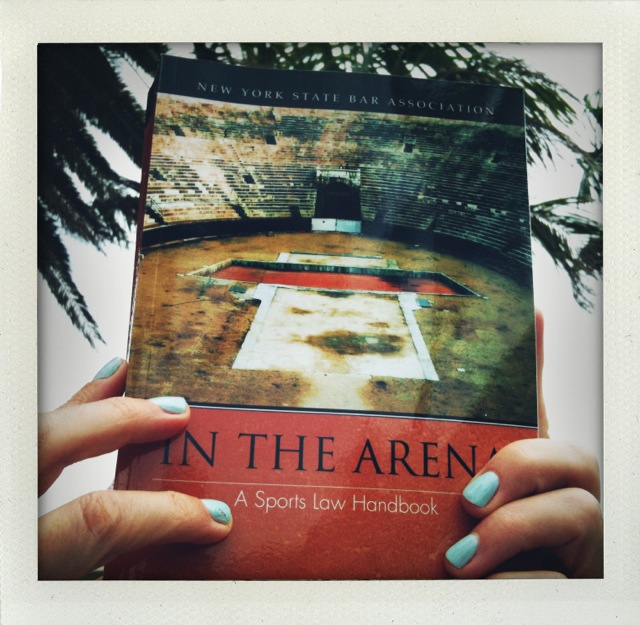
The New York State Bar Association has published a new book, In the Arena, A Sports Law Handbook.

The book features 15 chapters each presenting a particular topic. I had the pleasure writing its chapter 14, An Introduction to European Union Sports Law.

Other chapters deal with the law of mascots, right of publicity, or collective bargaining. You can find the table of contents here.


Facebooktwitterredditpinterestlinkedinmailby feather